2026
Non-Abelian Mixer for QAOA on Hybrid Oscillator-Qubit Quantum Processors
Thinh Le, Hansika Weerasena, Jianqing Liu
IEEE Global Communications Conference (GLOBECOM) 2026
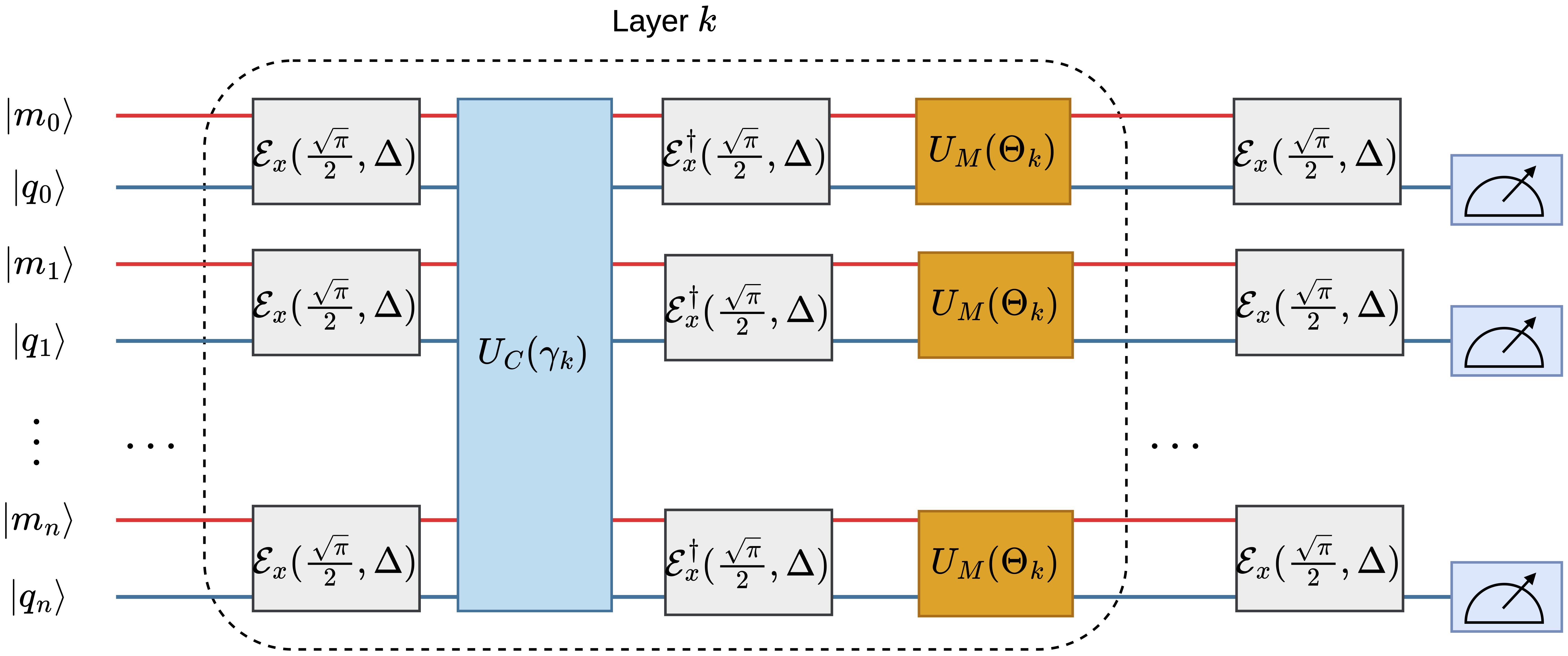
The realization of universal control in hybrid oscillator-qubit quantum processors enables the systematic design and implementation of quantum algorithms. However, the algorithmic development for such platforms remains at an early stage. While the Quantum Approximate Optimization Algorithm (QAOA) has been extensively studied in both continuous-variable (CV) and discrete-variable (DV) quantum systems, its development in the hybrid CV-DV setting remains limited. In this paper, we propose a hardware-native non-Abelian mixer for QAOA on hybrid CV-DV quantum processors and develop a corresponding hybrid ansatz for the Max-Cut problem. We evaluate the proposed ansatz on unweighted Erd$\H{o}$s-R$\'e$nyi graphs and benchmark it against the standard transverse-field mixer using the approximation ratio and optimal-solution probability. Across all graph sizes and Fock cutoffs in our simulations, the proposed non-Abelian mixer consistently improves both expected solution quality and the probability of sampling an optimal solution relative to the transverse-field mixer. These results indicate that the proposed non-Abelian mixer is a promising building block for QAOA on hybrid oscillator–qubit platforms.
Non-Abelian Mixer for QAOA on Hybrid Oscillator-Qubit Quantum Processors
Thinh Le, Hansika Weerasena, Jianqing Liu
IEEE Global Communications Conference (GLOBECOM) 2026
The realization of universal control in hybrid oscillator-qubit quantum processors enables the systematic design and implementation of quantum algorithms. However, the algorithmic development for such platforms remains at an early stage. While the Quantum Approximate Optimization Algorithm (QAOA) has been extensively studied in both continuous-variable (CV) and discrete-variable (DV) quantum systems, its development in the hybrid CV-DV setting remains limited. In this paper, we propose a hardware-native non-Abelian mixer for QAOA on hybrid CV-DV quantum processors and develop a corresponding hybrid ansatz for the Max-Cut problem. We evaluate the proposed ansatz on unweighted Erd$\H{o}$s-R$\'e$nyi graphs and benchmark it against the standard transverse-field mixer using the approximation ratio and optimal-solution probability. Across all graph sizes and Fock cutoffs in our simulations, the proposed non-Abelian mixer consistently improves both expected solution quality and the probability of sampling an optimal solution relative to the transverse-field mixer. These results indicate that the proposed non-Abelian mixer is a promising building block for QAOA on hybrid oscillator–qubit platforms.
2025
Partition Function Estimation Using Analog Quantum Processors
Thinh Le, Elijah Pelofske
Submitted to Nature Unconventional ComputingUnder review. 2025
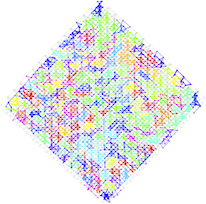
We evaluate using programmable superconducting flux qubit D-Wave quantum annealers to approximate the partition function of Ising models. We propose the use of two distinct quantum annealer sampling methods: chains of Monte Carlo-like reverse quantum anneals, and standard linear-ramp quantum annealing. The control parameters used to attenuate the quality of the simulations are the effective analog energy scale of the J coupling, the total annealing time, and for the case of reverse annealing the anneal-pause. The core estimation technique is to sample across the energy spectrum of the classical Hamiltonian of interest, and therefore obtain a density of states estimate for each energy level, which in turn can be used to compute an estimate of the partition function with some sampling error. This estimation technique is powerful because once the distribution is sampled it allows thermodynamic quantity computation at arbitrary temperatures. On a $25$ spin $\pm J$ hardware graph native Ising model we find parameter regimes of the D-Wave processors that provide comparable result quality to two standard classical Monte Carlo methods, Multiple Histogram Reweighting and Wang-Landau. Remarkably, we find that fast quench-like anneals can quickly generate ensemble distributions that are very good estimates of the true partition function of the classical Ising model; on a Pegasus graph-structured QPU we report a logarithmic relative error of $7.6 \times 10^{-6}$, from $171,000$ samples generated using $0.2$ seconds of QPU time with an anneal time of $8$ nanoseconds per sample which is interestingly within the closed system dynamics timescale of the superconducting qubits.
Partition Function Estimation Using Analog Quantum Processors
Thinh Le, Elijah Pelofske
Submitted to Nature Unconventional ComputingUnder review. 2025
We evaluate using programmable superconducting flux qubit D-Wave quantum annealers to approximate the partition function of Ising models. We propose the use of two distinct quantum annealer sampling methods: chains of Monte Carlo-like reverse quantum anneals, and standard linear-ramp quantum annealing. The control parameters used to attenuate the quality of the simulations are the effective analog energy scale of the J coupling, the total annealing time, and for the case of reverse annealing the anneal-pause. The core estimation technique is to sample across the energy spectrum of the classical Hamiltonian of interest, and therefore obtain a density of states estimate for each energy level, which in turn can be used to compute an estimate of the partition function with some sampling error. This estimation technique is powerful because once the distribution is sampled it allows thermodynamic quantity computation at arbitrary temperatures. On a $25$ spin $\pm J$ hardware graph native Ising model we find parameter regimes of the D-Wave processors that provide comparable result quality to two standard classical Monte Carlo methods, Multiple Histogram Reweighting and Wang-Landau. Remarkably, we find that fast quench-like anneals can quickly generate ensemble distributions that are very good estimates of the true partition function of the classical Ising model; on a Pegasus graph-structured QPU we report a logarithmic relative error of $7.6 \times 10^{-6}$, from $171,000$ samples generated using $0.2$ seconds of QPU time with an anneal time of $8$ nanoseconds per sample which is interestingly within the closed system dynamics timescale of the superconducting qubits.
Distributed Quantum Magnetic Sensing for Infrastructure-free Geo-localization
Thinh Le, Jianqing Liu, Jiapeng Zhao, Eneet Kaur
Submitted to IEEE Transactions on NetworkingUnder review. 2025
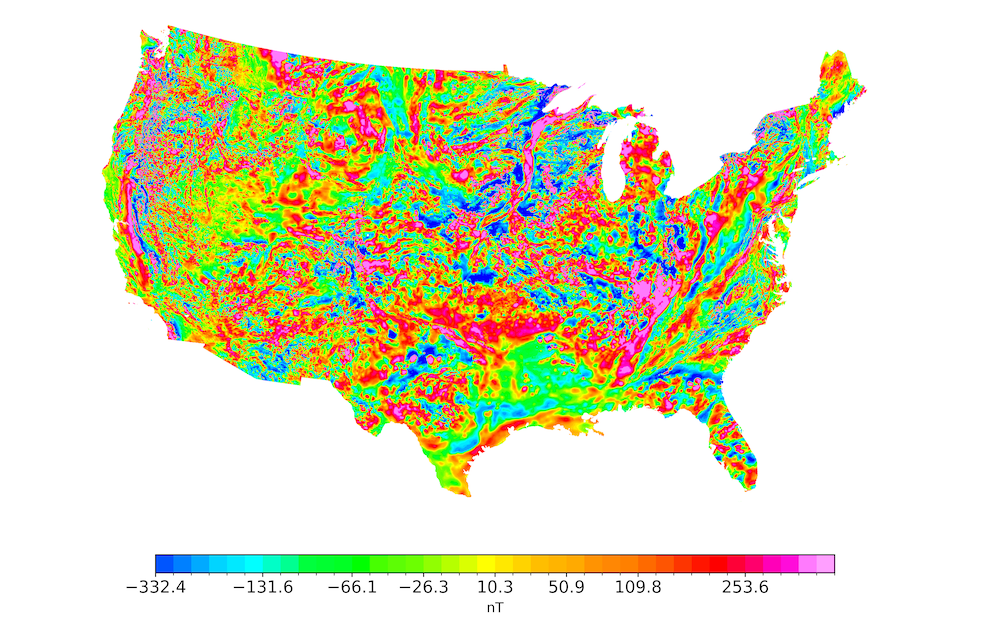
Modern navigation systems rely heavily on Global Navigation Satellite Systems (GNSS), whose weak spaceborne signals are vulnerable to jamming, spoofing, and line-of-sight blockage. As an alternative, the Earth's magnetic field entails location information and is found critical to many animals' cognitive and navigation behavior. However, the practical use of the Earth's magnetic field for geo-localization hinges on an ultra-sensitive magnetometer. This work investigates how quantum magnetic sensing can be used for this purpose. We theoretically derive the Cramér--Rao lower bound (CRLB) for the estimation error of quantum sensing when using a nitrogen-vacancy (NV) center and prove the quantum advantage over classical magnetometers. Moreover, we employ a practical distributed quantum sensing protocol to saturate CRLB. Based on the estimated magnetic field and the earth's magnetic field map, we formulate geo-localization as a map-matching problem and introduce a coarse-to-fine Mahalanobis distance search in both gradient space (local field derivatives) and corner space (raw field samples). We simulate the proposed quantum sensing-based geo-localization framework over four cities in the United States and Canada. The results report that in high-gradient regions, gradient-space Mahalanobis search achieves sub-kilometer median localization error; while in magnetically smoother areas, corner-space search provides better accuracy and a $4-8\times$ reduction in runtime.
Distributed Quantum Magnetic Sensing for Infrastructure-free Geo-localization
Thinh Le, Jianqing Liu, Jiapeng Zhao, Eneet Kaur
Submitted to IEEE Transactions on NetworkingUnder review. 2025
Modern navigation systems rely heavily on Global Navigation Satellite Systems (GNSS), whose weak spaceborne signals are vulnerable to jamming, spoofing, and line-of-sight blockage. As an alternative, the Earth's magnetic field entails location information and is found critical to many animals' cognitive and navigation behavior. However, the practical use of the Earth's magnetic field for geo-localization hinges on an ultra-sensitive magnetometer. This work investigates how quantum magnetic sensing can be used for this purpose. We theoretically derive the Cramér--Rao lower bound (CRLB) for the estimation error of quantum sensing when using a nitrogen-vacancy (NV) center and prove the quantum advantage over classical magnetometers. Moreover, we employ a practical distributed quantum sensing protocol to saturate CRLB. Based on the estimated magnetic field and the earth's magnetic field map, we formulate geo-localization as a map-matching problem and introduce a coarse-to-fine Mahalanobis distance search in both gradient space (local field derivatives) and corner space (raw field samples). We simulate the proposed quantum sensing-based geo-localization framework over four cities in the United States and Canada. The results report that in high-gradient regions, gradient-space Mahalanobis search achieves sub-kilometer median localization error; while in magnetically smoother areas, corner-space search provides better accuracy and a $4-8\times$ reduction in runtime.
Optimized GKP State for Bosonic Channel Sensing
Thinh Le, Jianqing Liu, Jiapeng Zhao, Eneet Kaur
IEEE International Conference on Quantum Computing and Engineering (QCE'25) 2025
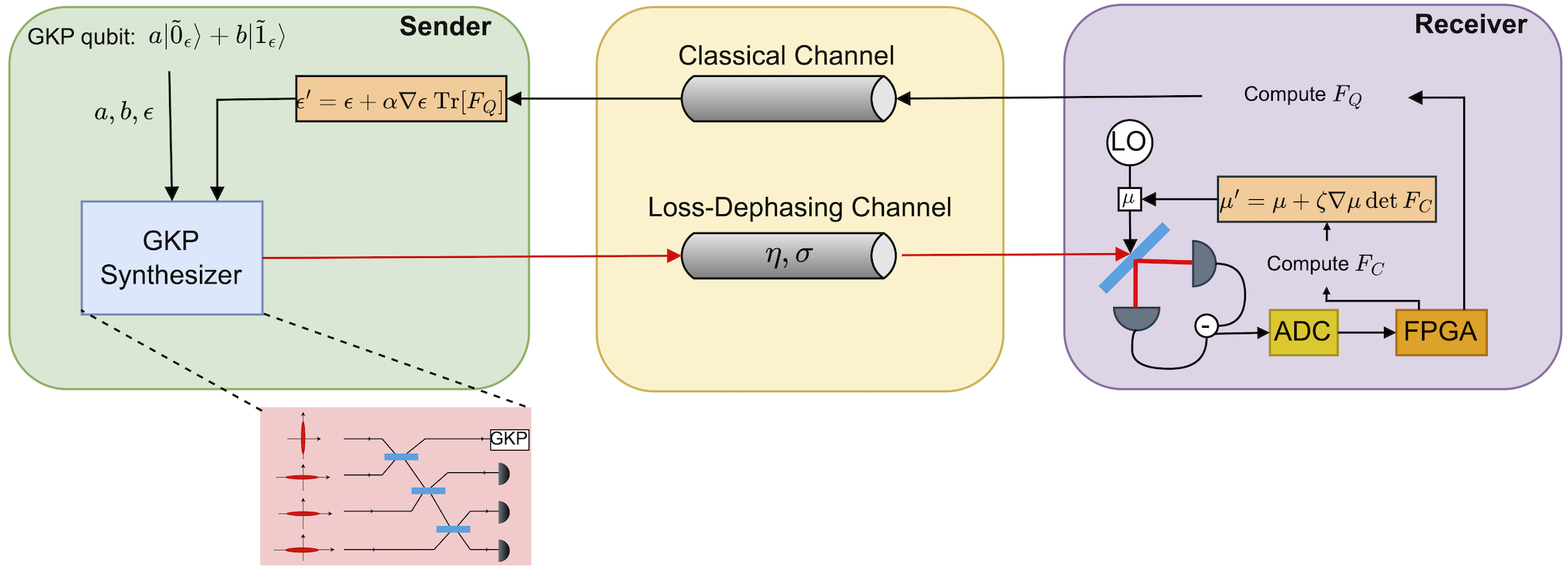
Bosonic quantum computation harnesses the infinite-dimensional Hilbert space of harmonic oscillators, offering scalable architectures with inherent error correction advantages over qubit-based systems. Despite their potential, bosonic modes encounter significant challenges from prevalent noise sources, particularly photon loss and dephasing, which degrade quantum coherence. Among bosonic error-correcting codes, the Gottesman-Kitaev-Preskill (GKP) code stands out for its ability to correct small phase-space displacements, enabling applications in quantum communication, sensing, and computation. While ideal GKP states require infinite squeezing and are unphysical, the finite squeezing approximate GKP states have been experimentally realized, though their performance depends critically on the squeezing level and measurement strategies. This work addresses a central challenge: how to optimize the squeezing parameter of approximate GKP states and the local oscillator (LO) phase in homodyne detection to maximize precision in estimating bosonic loss-dephasing channel parameters. To address this question, we introduce an adaptive optimization framework guided by classical Fisher information (CFI) and quantum Fisher information (QFI). Numerical simulations demonstrate that this adaptive protocol consistently converges to optimal parameter configurations, determining optimized squeezing levels and LO phases. By offering a practical approach to high-precision quantum channel parameter estimation, this framework has broad implications, from quantum metrology to enabling robust quantum communication systems.
Optimized GKP State for Bosonic Channel Sensing
Thinh Le, Jianqing Liu, Jiapeng Zhao, Eneet Kaur
IEEE International Conference on Quantum Computing and Engineering (QCE'25) 2025
Bosonic quantum computation harnesses the infinite-dimensional Hilbert space of harmonic oscillators, offering scalable architectures with inherent error correction advantages over qubit-based systems. Despite their potential, bosonic modes encounter significant challenges from prevalent noise sources, particularly photon loss and dephasing, which degrade quantum coherence. Among bosonic error-correcting codes, the Gottesman-Kitaev-Preskill (GKP) code stands out for its ability to correct small phase-space displacements, enabling applications in quantum communication, sensing, and computation. While ideal GKP states require infinite squeezing and are unphysical, the finite squeezing approximate GKP states have been experimentally realized, though their performance depends critically on the squeezing level and measurement strategies. This work addresses a central challenge: how to optimize the squeezing parameter of approximate GKP states and the local oscillator (LO) phase in homodyne detection to maximize precision in estimating bosonic loss-dephasing channel parameters. To address this question, we introduce an adaptive optimization framework guided by classical Fisher information (CFI) and quantum Fisher information (QFI). Numerical simulations demonstrate that this adaptive protocol consistently converges to optimal parameter configurations, determining optimized squeezing levels and LO phases. By offering a practical approach to high-precision quantum channel parameter estimation, this framework has broad implications, from quantum metrology to enabling robust quantum communication systems.
A Two-stage Optimization Method for Wide-range Single-electron Quantum Magnetic Sensing
Shiqian Guo, Jianqing Liu, Thinh Le, Huaiyu Dai
Submitted to Nature Portfolio Journal-Quantum Information (NPJ QI)Under review. 2025
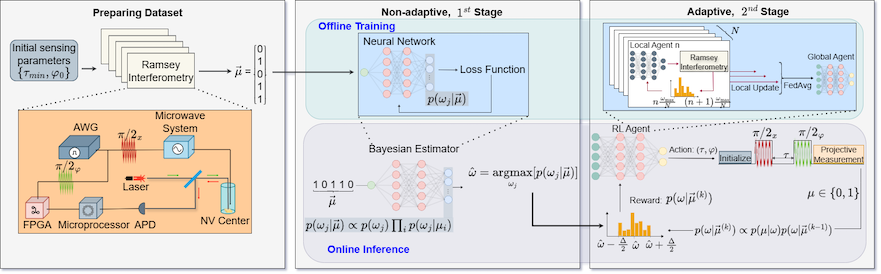
Quantum magnetic sensing is a new paradigm for detecting ultra-weak magnetic fields. Its protocol design concerns the devise of optimal sensing parameters to estimate the underlying signals of interest (SoI). Existing studies mainly rely on adaptive algorithms based on black-box AI models or formula-driven principled searches. However, when the SoI spans a wide range and the quantum sensor has physical constraints, these methods may fail to converge efficiently or optimally, causing prolonged interrogation times and reduced accuracy. This work presents a new protocol using a two-stage optimization method, consisting of a Bayesian neural network to first narrow the SoI range and a federated reinforcement learning agent to subsequently calibrate the SoI. The protocol is developed and evaluated in the challenging context of an NV-center spin system with single-shot readout and limited sensing time; and yet it achieves significant improvements in both accuracy and resource efficiency compared to the state-of-the-art.
A Two-stage Optimization Method for Wide-range Single-electron Quantum Magnetic Sensing
Shiqian Guo, Jianqing Liu, Thinh Le, Huaiyu Dai
Submitted to Nature Portfolio Journal-Quantum Information (NPJ QI)Under review. 2025
Quantum magnetic sensing is a new paradigm for detecting ultra-weak magnetic fields. Its protocol design concerns the devise of optimal sensing parameters to estimate the underlying signals of interest (SoI). Existing studies mainly rely on adaptive algorithms based on black-box AI models or formula-driven principled searches. However, when the SoI spans a wide range and the quantum sensor has physical constraints, these methods may fail to converge efficiently or optimally, causing prolonged interrogation times and reduced accuracy. This work presents a new protocol using a two-stage optimization method, consisting of a Bayesian neural network to first narrow the SoI range and a federated reinforcement learning agent to subsequently calibrate the SoI. The protocol is developed and evaluated in the challenging context of an NV-center spin system with single-shot readout and limited sensing time; and yet it achieves significant improvements in both accuracy and resource efficiency compared to the state-of-the-art.
2024
The Road to Quantum Internet: Progress in Quantum Network Testbeds and Major Demonstrations
Jianqing Liu#, Thinh Le, Tingxiang Ji, Ruozhou Yu, Demitry Farfurnik, Greg Bryd, Daniel Stancil (# corresponding author)
Elsevier Progress in Quantum Electronics 2024
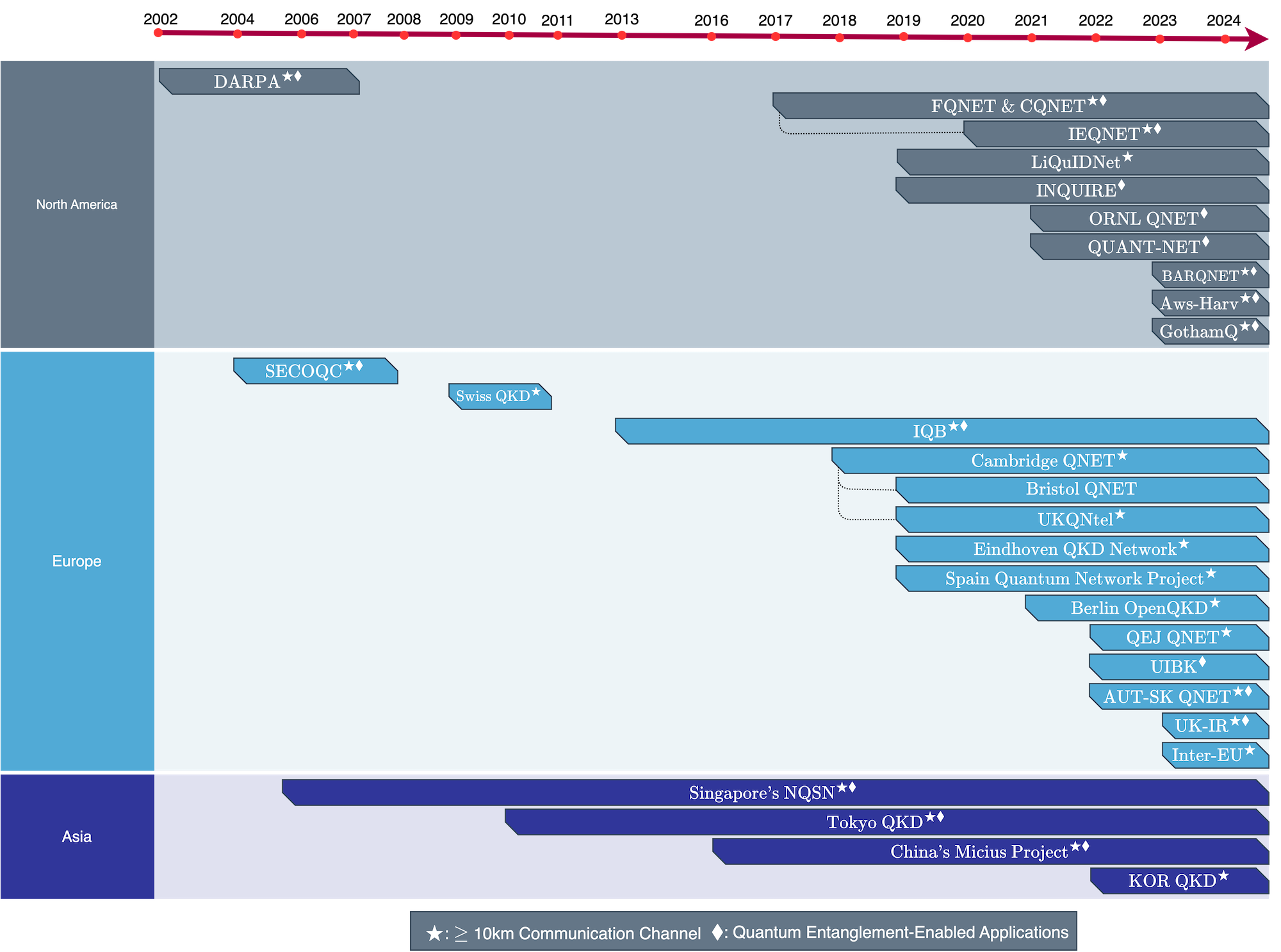
The quantum internet is on the cusp of a revolution. While it shares the same purpose as the classical internet --- connecting devices and transmitting information, the underlying principle of quantum physics makes the quantum internet a disruptive technology that will enable services unmatched by the classical internet. The quantum internet design has moved beyond theory. The past decade has seen a surge of efforts among researchers worldwide in building quantum network testbeds, a crucial stepping stone toward the quantum internet. In this review paper, we will summarize recent progress on quantum network testbeds, highlighting their major demonstrations and achievements. This progress report is the first of its kind in the literature, offering a holistic view of past regional efforts and prompting the community to assess our current position. Moreover, this paper will discuss open challenges and envision a collaborative pathway forward for the development of the quantum internet.
The Road to Quantum Internet: Progress in Quantum Network Testbeds and Major Demonstrations
Jianqing Liu#, Thinh Le, Tingxiang Ji, Ruozhou Yu, Demitry Farfurnik, Greg Bryd, Daniel Stancil (# corresponding author)
Elsevier Progress in Quantum Electronics 2024
The quantum internet is on the cusp of a revolution. While it shares the same purpose as the classical internet --- connecting devices and transmitting information, the underlying principle of quantum physics makes the quantum internet a disruptive technology that will enable services unmatched by the classical internet. The quantum internet design has moved beyond theory. The past decade has seen a surge of efforts among researchers worldwide in building quantum network testbeds, a crucial stepping stone toward the quantum internet. In this review paper, we will summarize recent progress on quantum network testbeds, highlighting their major demonstrations and achievements. This progress report is the first of its kind in the literature, offering a holistic view of past regional efforts and prompting the community to assess our current position. Moreover, this paper will discuss open challenges and envision a collaborative pathway forward for the development of the quantum internet.
Detecting Anomaly in Smart homes based on Mahalanobis Distance
Hoang M. Ngo, Do H. Ha, Quan D. Pham, Thinh V. Le, Son H. Nguyen# (# corresponding author)
IEEE International Conference on Communications (ICC'24) 2024
Detecting Anomaly in Smart homes based on Mahalanobis Distance
Hoang M. Ngo, Do H. Ha, Quan D. Pham, Thinh V. Le, Son H. Nguyen# (# corresponding author)
IEEE International Conference on Communications (ICC'24) 2024
2023
Benchmarking Chain Strength: An Optimal Approach for Quantum Annealing
Thinh Le, Manh Nguyen, Thang Dinh, Ivan Djordjevic, Zhi-Li Zhang, Tu Nguyen
IEEE International Conference on Quantum Computing and Engineering (QCE'23) 2023
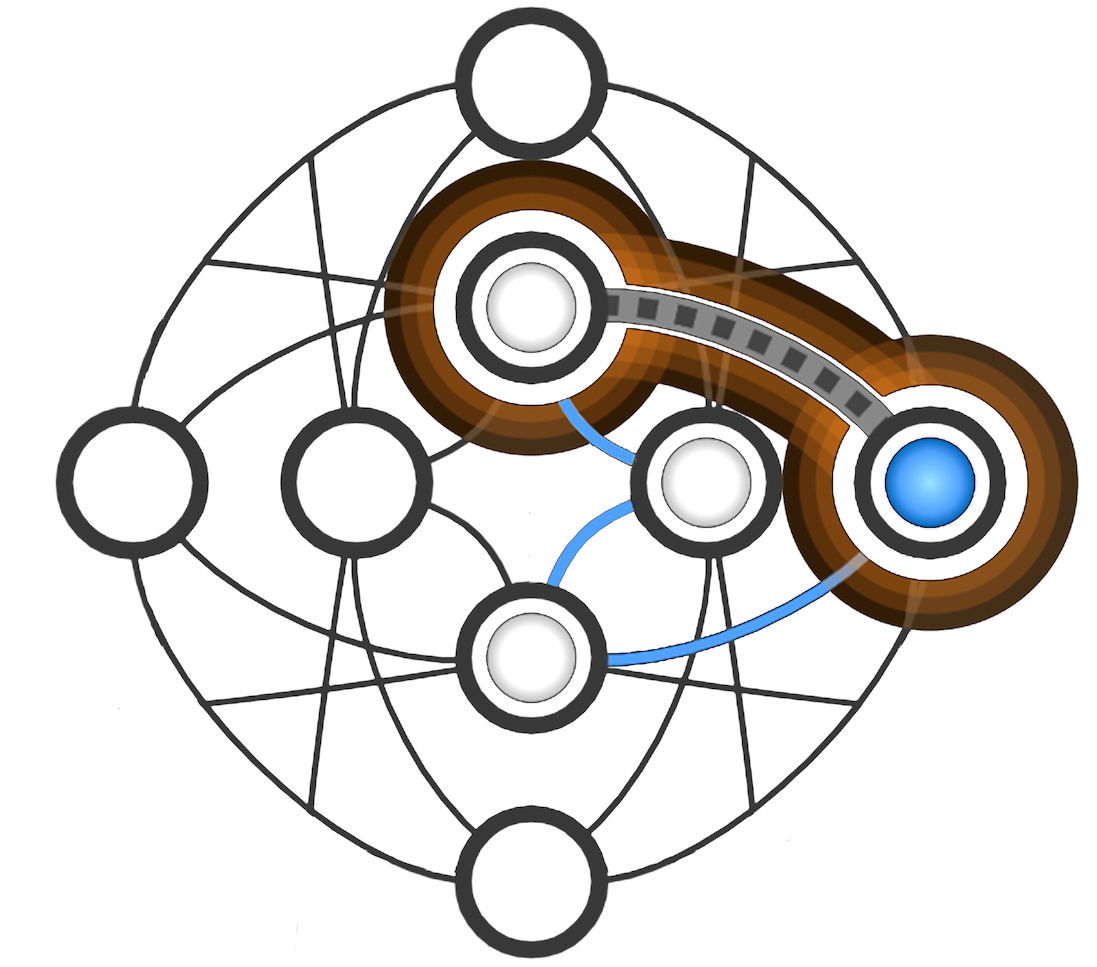
Quantum annealing (QA) is a promising optimization technique used to find global optimal solution of a combinatorial optimization problem by leveraging quantum fluctuations. In QA, the problem being solved is mapped onto the quantum processing unit (QPU) composed of qubits through a procedure called minor-embedding. The qubits are connected by a network of couplers, which determine the strength of the interactions between the qubits. The strength of the couplers that connect qubits within a chain is often referred to as the chain strength. The appropriate balance of chain strength is equally imperative in enabling the qubits to interact with one another in a way that is strong enough to obtain the optimal solution, but not excessively strong so as not to bias the original problem terms. To this end, we address the problem of identifying the optimal chain strength through the utilization of Path Integral Monte Carlo (PIMC) quantum simulation algorithm. The results indicate that our judicious choice of chain strength parameter facilitates enhancements in quantum annealer performance and solution quality, thereby paving the way for QA to compete with, or potentially outperform, classical optimization algorithms.
Benchmarking Chain Strength: An Optimal Approach for Quantum Annealing
Thinh Le, Manh Nguyen, Thang Dinh, Ivan Djordjevic, Zhi-Li Zhang, Tu Nguyen
IEEE International Conference on Quantum Computing and Engineering (QCE'23) 2023
Quantum annealing (QA) is a promising optimization technique used to find global optimal solution of a combinatorial optimization problem by leveraging quantum fluctuations. In QA, the problem being solved is mapped onto the quantum processing unit (QPU) composed of qubits through a procedure called minor-embedding. The qubits are connected by a network of couplers, which determine the strength of the interactions between the qubits. The strength of the couplers that connect qubits within a chain is often referred to as the chain strength. The appropriate balance of chain strength is equally imperative in enabling the qubits to interact with one another in a way that is strong enough to obtain the optimal solution, but not excessively strong so as not to bias the original problem terms. To this end, we address the problem of identifying the optimal chain strength through the utilization of Path Integral Monte Carlo (PIMC) quantum simulation algorithm. The results indicate that our judicious choice of chain strength parameter facilitates enhancements in quantum annealer performance and solution quality, thereby paving the way for QA to compete with, or potentially outperform, classical optimization algorithms.
Quantum Annealing Approach for Selective Traveling Salesman Problem
Thinh Le, Manh Nguyen, Sri Khandavilli, Thang Dinh, Tu Nguyen
IEEE International Conference on Communications (ICC'23) 2023
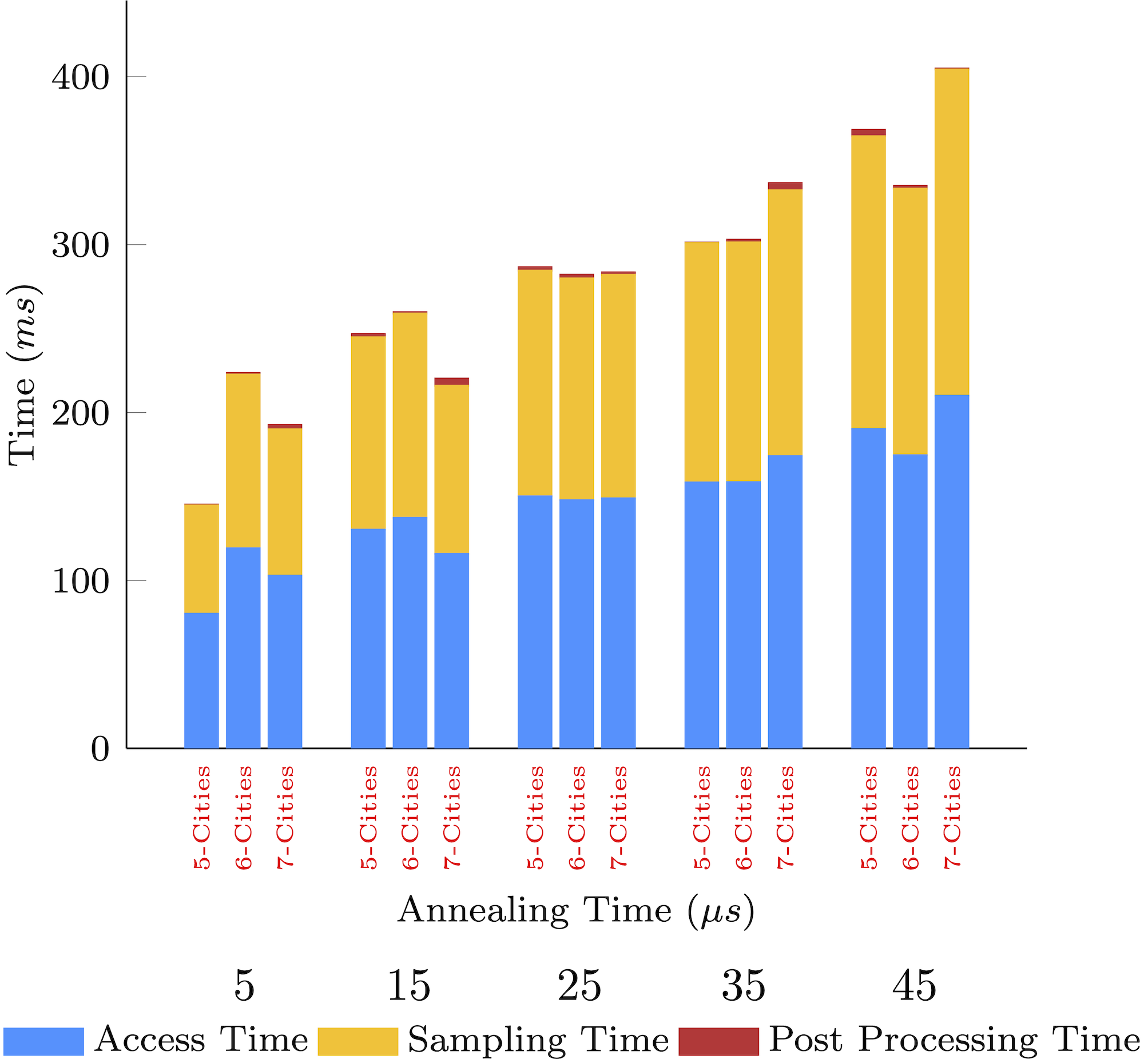
The Selective Traveling Salesman Problem (STSP) is a reasonably common variant of the Traveling Salesman Problem (TSP). This variation factors in the resource limitation of the salesman against his objective of maximizing the rewards collected at each city he arrives, which is especially useful in such fields as logistic optimization. STSP has been proven to be an NP-Hard problem and many research proposing classical heuristic solutions has been published over the years. In this paper, we examine Quantum Annealing (QA), an optimization procedure grounded on the principle of adiabatic quantum computation, in solving STSP. In particular, we propose the reformulation of the combinatorial problem STSP into the Quadratic Unconstrained Binary Optimization (QUBO) model, a model that can be embedded into the quantum annealer. We execute experiments with our presented formulation on the D-Wave quantum hardware and retrieve optimal solutions for a small number of instances.
Quantum Annealing Approach for Selective Traveling Salesman Problem
Thinh Le, Manh Nguyen, Sri Khandavilli, Thang Dinh, Tu Nguyen
IEEE International Conference on Communications (ICC'23) 2023
The Selective Traveling Salesman Problem (STSP) is a reasonably common variant of the Traveling Salesman Problem (TSP). This variation factors in the resource limitation of the salesman against his objective of maximizing the rewards collected at each city he arrives, which is especially useful in such fields as logistic optimization. STSP has been proven to be an NP-Hard problem and many research proposing classical heuristic solutions has been published over the years. In this paper, we examine Quantum Annealing (QA), an optimization procedure grounded on the principle of adiabatic quantum computation, in solving STSP. In particular, we propose the reformulation of the combinatorial problem STSP into the Quadratic Unconstrained Binary Optimization (QUBO) model, a model that can be embedded into the quantum annealer. We execute experiments with our presented formulation on the D-Wave quantum hardware and retrieve optimal solutions for a small number of instances.
Optimizing Resource Allocation and VNF Embedding in RAN Slicing
Tu Nguyen, Thinh Le, Manh Nguyen, Hoa Nguyen, Son Vu
IEEE Transactions on Network and Service Management 2023
Optimizing Resource Allocation and VNF Embedding in RAN Slicing
Tu Nguyen, Thinh Le, Manh Nguyen, Hoa Nguyen, Son Vu
IEEE Transactions on Network and Service Management 2023
Maximizing Key Distribution Capability: An Application in Quantum Cryptography
Tu Nguyen, Dung Nguyen, Manh Nguyen, Thinh Le, Bing-Hong Liu, Thang Dinh
IEEE International Conference on Quantum Computing and Engineering (IEEE QCE'23) 2023
Maximizing Key Distribution Capability: An Application in Quantum Cryptography
Tu Nguyen, Dung Nguyen, Manh Nguyen, Thinh Le, Bing-Hong Liu, Thang Dinh
IEEE International Conference on Quantum Computing and Engineering (IEEE QCE'23) 2023
Towards Fidelity-Optimal Qubit Mapping on NISQ Computers
Sri Khandavilli, Indu Palanisamy, Manh Nguyen, Thinh Le, Thang Dinh, Tu Nguyen
IEEE International Conference on Quantum Computing and Engineering (IEEE QCE'23) 2023
Towards Fidelity-Optimal Qubit Mapping on NISQ Computers
Sri Khandavilli, Indu Palanisamy, Manh Nguyen, Thinh Le, Thang Dinh, Tu Nguyen
IEEE International Conference on Quantum Computing and Engineering (IEEE QCE'23) 2023